



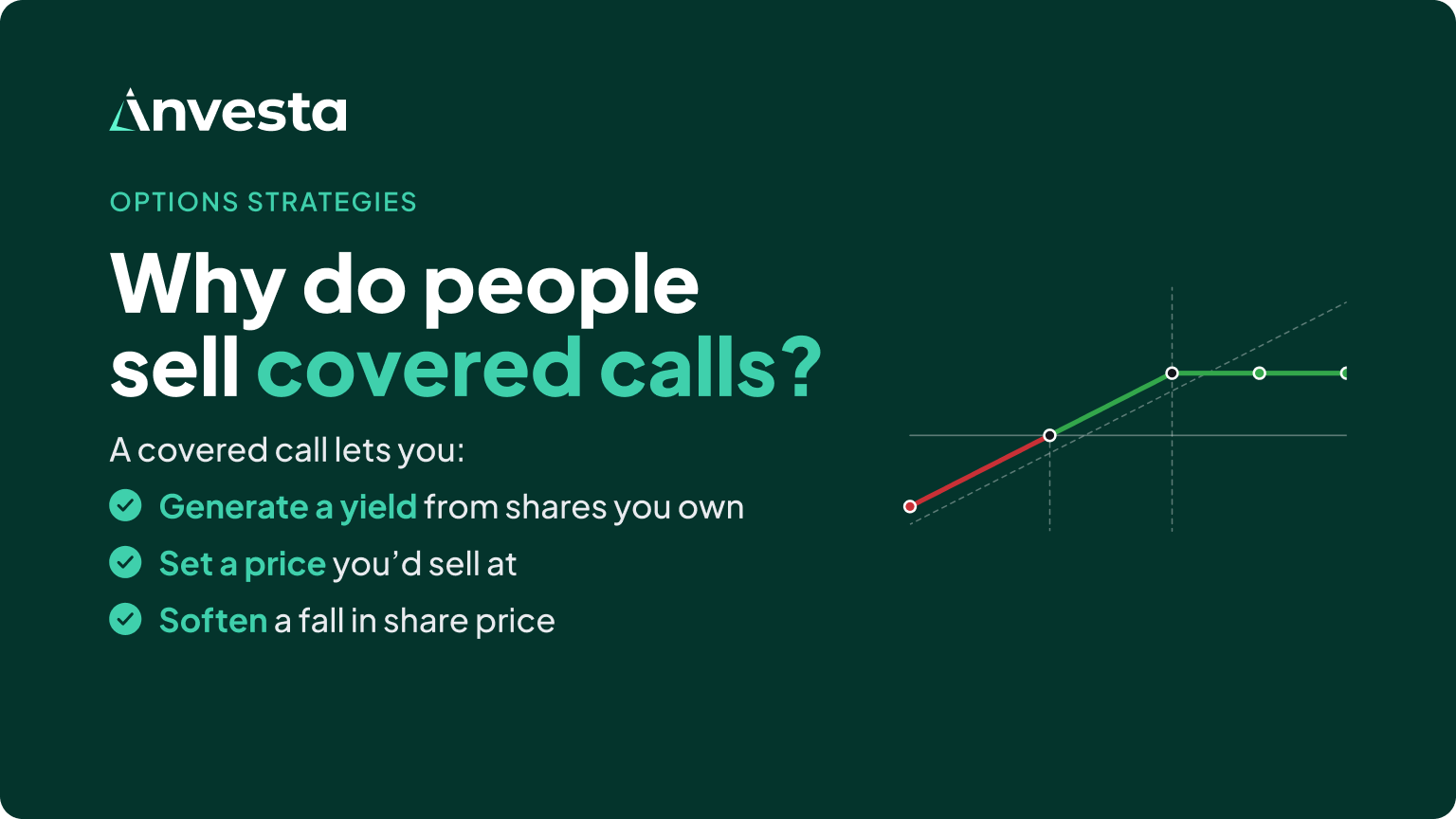
What is a covered call?
When you buy a call, you get the right, but not the obligation, to buy a share at a fixed price (strike price) on or before a set date (expiration date).
When you sell (or “write”) a call, you take the other side. Someone pays you a fee, called the premium, and in return you take on the obligation to sell them your shares at the strike price if they choose to buy.
The call is covered because you already own the shares you might have to sell. One contract usually covers 100 shares, so you need at least 100 shares for each call you sell.
If the share price is below the strike price at the expiration date, the call usually expires worthless. You keep your shares and the premium.
If the share price is above the strike price, the buyer will usually exercise. Your shares are sold at the strike price, and you keep the premium. This is called assignment.
As the share price moves up and down, the value of the call will also change.
You are not required to hold the call until the expiration date and can buy it back beforehand. This may cost more or less than the premium you received.
When do people use covered calls?
Investors often sell covered calls when they expect a share price to stay flat or rise slowly, and they’d be happy to sell at the strike price if it rises.
- If the share price doesn’t move, you keep the premium. As long as the share price is below the strike price at the expiration date, the call expires worthless and you keep your shares and the premium. Say you own shares bought at $50 and receive a $2 premium. If the share price is still $50 at the expiration date, you make $2 a share, where simply holding the shares would make nothing.
- The premium lowers the cost of your shares. Each premium you receive reduces what you’ve effectively paid. After a $2 premium, shares you bought at $50 work out at $48 each.
Covered calls are less useful if you expect a big rise in the share price, because your gain is capped at the strike price, or if you might want to sell your shares at short notice, because the shares are locked while the call is open. And if the share price falls instead, you may still lose money on the shares. The premium helps to offset some of the loss.
Think of it like taking a reservation fee for your house
Remember the reservation fee from our guide to buying calls? This time, you’re the seller. Say you own a house worth $300,000. A buyer pays you a $5,000 reservation fee that you keep, whatever happens. In return, you agree to sell them the house for $300,000 if they want it within the next three months.
- If house prices rise to $350,000, they’ll buy. You must sell for $300,000 and you keep the $5,000, but you miss out on the $50,000 rise.
- If prices stay flat, they won’t buy. You keep the house and the $5,000.
- If prices fall to $250,000, they won’t buy. You keep the $5,000, but your house is now worth $50,000 less.
A covered call works in much the same way. The $300,000 agreed price is the strike price, the $5,000 reservation fee is the premium, and the three months is the expiration date.
Key terms
Thinking in yield
Many investors look at a covered call in terms of yield: how much income the premium gives you compared with the value of your shares.
Say you bought shares at $50 and sold a three-month call with a $55 strike price for a $2 premium. Your yield is $2 ÷ $50 = 4% over three months.
Some investors annualise this to compare it with other income, such as dividends or interest on savings. If you sold a similar call every three months and earned around 4% each time, that would add up to roughly 16% a year.
Investors also look at the return if their shares are sold at the strike price: the $2 premium plus the $5 rise in the share price from $50 to $55, so $7 ÷ $50 = 14%.
Yield isn’t the same as profit. You keep the premium whatever happens, but if the share price falls by more than the premium, you still lose money overall.
What happens when the call expires?
What you can do next depends on what happened to your shares.
- The call expired worthless. You keep your shares and the $2 premium. You’re then free to sell another call on the same shares, and many investors do this regularly to collect a new premium each time. That’s the idea behind the annualised yield above.
- Your shares were sold at the strike price. You keep the $2 premium and receive $55 a share, but you no longer own the shares. To sell another covered call, you’d need to buy shares again.
Each new call is a new trade, with its own premium, strike price and expiration date.
A worked example
This example is hypothetical. It uses a made-up company and ignores fees, commissions and currency costs.
You own 100 shares in Example Co, which you bought at $50. They still trade at $50. You sell one call option on them:
- Strike price: $55
- Expiration date: three months away
- Premium: $2
You receive the $2 premium up front and keep it, whatever happens.
The premium lowers your breakeven on the shares: $50 − $2 = $48. If the shares fall below that, you’re making a loss overall.
- Your downside is reduced compared with just owning the shares. The premium lowers any loss by $2 a share. If Example Co fell to $40, you’d lose $8 a share (−16%), compared with $10 (−20%) if you’d only held the shares.
- The most you can make is $7 a share (+14%). That’s the $5 rise from $50 to the $55 strike price, plus the $2 premium. This is reached at $55 and doesn’t grow above it.
Here’s what the trade looks like at the expiration date for a range of share prices, next to what you’d have if you’d simply held the shares. Percentages are of the $50 you paid for each share:
Below $48, you lose money, just less than if you’d only held the shares. Above $57, you’d have done better without the covered call.
What you can lose
When you sell a covered call, you keep almost all the risk of owning the shares, and you give up most of the reward above the strike price.
- You can still lose most of your investment. The premium only cushions a fall by the amount you received. In the example, that’s $2 a share on shares that cost $50.
- Your gain is capped. However high the share price goes, the most you make is the strike price plus the premium. If Example Co jumped to $80, you’d still make $7 a share (+14%), not $30 (+60%).
- Your shares can be sold earlier than you expect. The buyer can usually exercise at any time before the expiration date. This is more likely just before a company pays a dividend.
- Closing early can cost more than you received. If the share price rises, buying the call back can cost more than the premium you were paid.
- Your shares are locked while the call is open. On Investa, you can’t sell them until the contract ends or you buy the call back. If the share price falls sharply, you can’t sell the shares to limit your loss without closing the call first.
All figures in this guide are shown per share and ignore fees, commissions and currency costs. Usually one options contract covers 100 shares, so the premium you receive and any profit or loss are 100 times the amounts shown. For example, a $2 premium pays you $200 for one contract.