



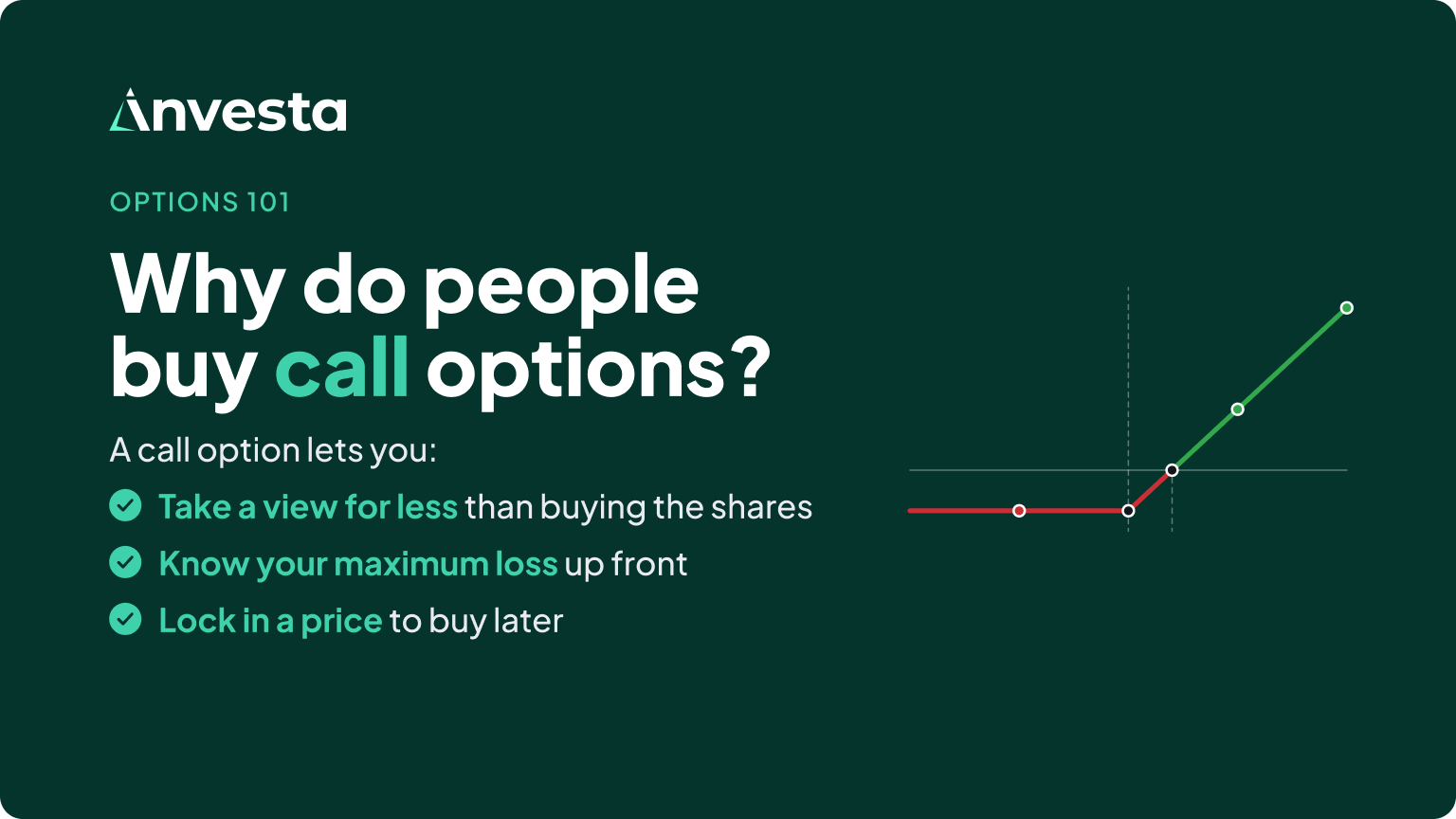
What is a call?
A call option gives you the right, but not the obligation (an option), to buy a share at a fixed price (strike price) on or before a set date (expiration date).
For this right, you pay a fee, called the premium.
If the share price is below the strike price at the expiration date, the option expires worthless, you don’t buy the shares, and you lose the premium you paid.
As the share price moves up and down, the value of the option will also change.
You are not required to hold the option until the expiration date and can sell it beforehand.
Think of it like a reservation fee for a house
Say you find a house for $300,000. You pay the seller a $5,000 reservation fee for the right to buy the house for $310,000 within three months.
- If during that time prices jump and the house is now worth $340,000, you have the right to buy it at $310,000, making $25,000 after the $5,000 fee.
- If prices stay flat or fall, you walk away and lose the $5,000 and nothing more.
A call option works in much the same way. The $310,000 agreed price is the strike price, the $5,000 reservation fee is the premium, and the end of the three months is the expiration date.
Key terms
A worked example
This example is hypothetical. It uses a made-up company and ignores fees, commissions and currency costs.
Shares in Example Co trade at $100. You think the price might rise, so you buy one call option that expires in three months:
To make your money back, the share price has to rise above the strike price by at least the premium you paid. This is known as the breakeven.
Here’s what the trade looks like at the expiration date for a range of share prices, next to what you’d make if you’d bought one share at $100 instead. Percentages are of what you paid: $5 for the call and $100 for the share.
In percentage terms, the call’s gains and losses are much bigger than the shares’. That’s leverage, and it works both ways.
What you can lose
When you buy a call, the most you can lose is the premium you paid.
- You can lose 100% of what you put in. At the expiration date, if the share price isn’t above the strike price, the call expires worthless.
- Being right about the direction isn’t always enough. In the example, the shares rose from $100 to $105 but didn’t go past the strike price, so you lost the full $5 premium. Importantly, the share price has to move far enough, and soon enough.
- Time works against you. An option loses value as the expiration date gets closer, even when the share price stays flat. This is called time decay.
- Leverage goes both ways. A small move in the share price can mean a large percentage gain or loss on the option.
All figures in this guide are shown per share. Usually one options contract covers 100 shares, so the premium you pay and any profit or loss are 100 times the amounts shown. For example, a $5 premium costs $500 for one contract.